
RESOURCES | RENOGIZE BLOG
Leadership Insights for Transforming Teams and Organizations
The Latest Articles by Renogize Coaches
Leadership and AI: Cultivating Curiosity in an AI-Saturated World
It’s tempting to feel certain when answers are at our fingertips. Ask your favorite AI, and a confident-sounding answer appears in seconds. But AI has blind spots. It reinforces existing perspectives and mistakes plausibility for truth. And it lacks the lived organizational and relational context that leaders and their teams experience every day.
So what does it look like to cultivate curiosity when certainty feels more comfortable? What questions push teams beyond the easy answers? Which are best asked of AI and which of humans?
Leadership and AI: AI Changes the Work, Not the Need for Trust
I’m hearing two very different conversations about AI.
Leaders and decision-makers are excited about the possibilities. They see greater efficiencies, time saved, and ultimately, greater return. And oftentimes, I find leaders assume their people will be just as excited.
But I’m hearing something different from employees.
What does this mean for my job? Will my role change? If AI can do some of my work, where does that leave me?
AI and Leadership: What Should Stay Human
The usage of AI has been brought up by almost every single one of my clients in the last couple of years. Leaders everywhere are looking to see what part AI can and will play in their companies. Rightfully so; efficiencies abound! The challenge is managing the tension between efficiency and responsibility. What COULD we use AI to help with vs. what SHOULD we use AI to help with?
AI is a wonderful tool, and you risk being left behind if you and your company fail to integrate it in some capacity. However, if the task requires thoughtful introspection, discernment, or creativity, it is probably best left for you and your other carbon-based teammates.
Leading Through Change: Holding the Team Together When Everything Else is Shifting
Is it just me, or does organizational change feel particularly hard right now?
You’re not imagining it. Change used to be episodic — a new system here, a reorg there. Today, change is constant, overlapping, and often driven by external factors we can’t control. Teams are navigating shifting priorities, redefined roles, technological disruption, and emotional fatigue all at once. The pace is faster, the stakes feel higher, and people have less capacity to absorb the disruption.
This means leaders can’t rely on old playbooks. Supporting teams through change now requires more intention and more humanity than ever before. Team cohesion doesn’t happen by accident — it’s something leaders must actively cultivate, especially during change.
The Change Impact Leaders Often Miss
“I’m still the same person, only now I have new responsibilities.”
A client said this after being promoted to lead the team he had been part of for years. His peers became his direct reports, and while the role changed overnight, the relationships did not know how to change with it.
That is one of the quiet losses change can create.
Leading and Influencing Through Change
“The times, they are a changin’.”
Bob Dylan wrote that over 60 years ago, however the pace of change seems to be rapidly increasing. Some of your team members love change and thrive in it, while others experience stress and anxiety just thinking about change happening.
If change is a constant, then the question becomes, “How do I lead myself and others through change?”

Leading the Next Generation: Why Intentional Leadership Matters More Than Ever
Gen Z has become one of the most talked-about generations in the workplace. As a 24-year-old professional working alongside experienced leaders, I see a different reality. For many, Gen Z is framed as a challenge to solve. In reality, leading the next generation is not complicated. It requires leaders to be intentional in how they create clarity, build trust, and develop their people.
The key to supporting your people is understanding the individual and their values. Leadership is most effective when it provides clarity, purpose, and authenticity. Gen Z wants to understand not only what we are doing, but why it matters.
The Hidden Driver of Generational Conflict at Work
A Millennial leader I recently coached shared her frustration with a Gen Z team member. She leads a large team, carries her own workload, and expected this employee to take more initiative when challenges arose. Instead, he frequently brought problems to her before attempting solutions himself.
She asked him to research first and return with options. He didn’t. The frustration grew on both sides.
At first glance, it looked like avoidance. It wasn’t. It was a communication gap shaped by different beliefs about ownership and growth. Let’s take a look...

A Letter to Gen X
Dear Gen X,
Can we talk? We have something to share that may make you feel uncomfortable.
It is time to delegate. We know. We know. Hear us out, though. We know you are great at what you do. We know you can do everything, that you don’t need help from anyone. You are resilient, resourceful, and the epitome of independent. Don’t take this the wrong way, though. It’s just that we feel that we (collectively) could all be doing more.
Read the Room: Social Awareness as a Leadership Superpower
Most leaders don’t lose credibility because they lack technical skill or knowledge. They lose it because they misread the room. A tense silence goes unnoticed. A team’s hesitation is ignored. Raised eyebrows signal resistance, but the leader keeps charging forward.
On the other hand, highly effective leaders notice when energy dips, when tension rises, and when someone has something to say but isn’t speaking up. This ability to read the room is called social awareness. When leaders see what’s actually happening rather than what they hope is happening, they make better decisions, build trust faster, and guide teams through complexity.

Leadership Doesn't End at the Office Door
I recently attended a conference for coaches where a sponsor walked on stage to introduce the keynote. Before he did, he paused and said, “I know I’m not supposed to do this, but since you’re all coaches, I have a story.”
He shared what it was like as a young boy when his father came home from work each night. He didn’t go into great detail—he simply said, “My father’s boss was horrible.” And then he told us what he heard and saw: a father worn down, defeated, depressed, convinced he could never do anything right for his boss.
Then he said something that will stay with me for a long time: “I wonder what my childhood might have been like… what my relationship with my father might have been like… if his boss had a professional coach. Or if my father had one. Maybe I might have been raised differently if someone had helped him or his boss.”
The Platinum Rule
Do you know what “The Golden Rule” is? “Do unto others as you would have them do unto you.” Most of us had this idiom beaten into us when we were younger so we would play nicely with others. It was very helpful on the playground, but when it comes to leadership it sometimes misses the mark.
I recently worked with a company whose makeup is becoming increasingly common. They were mostly a group of Gen X executives who were leading Millennial leaders who were trying to motivate Gen Z front line employees. In a prep meeting with their CEO, generational stereotypes seemed to be getting in the way of them maximizing their capabilities. Gen X leaders wanted independence and to figure things out on their own. Millennials wanted to work collaboratively on everything and tried to move up the ladder too quickly. Gen Z showed themselves to be isolated and unsure of themselves. They were speaking past each other at all levels and despite their incredible success as a company, they weren’t meeting their potential. It was time to introduce them to the “Platinum Rule” of leadership.
What’s Your Leadership Theme?
The best leaders lead themselves first. Knowing the theme of your leadership story can be incredibly helpful, both in knowing where and how you lead most effectively.
Here’s an example.
I grew up in a town with an incredibly successful high school baseball program. My friends and I grew up dreaming of wearing the red and white on varsity. I was on that path until a rotator cuff injury derailed my chance to start at first base as a senior. My career as a player was over.
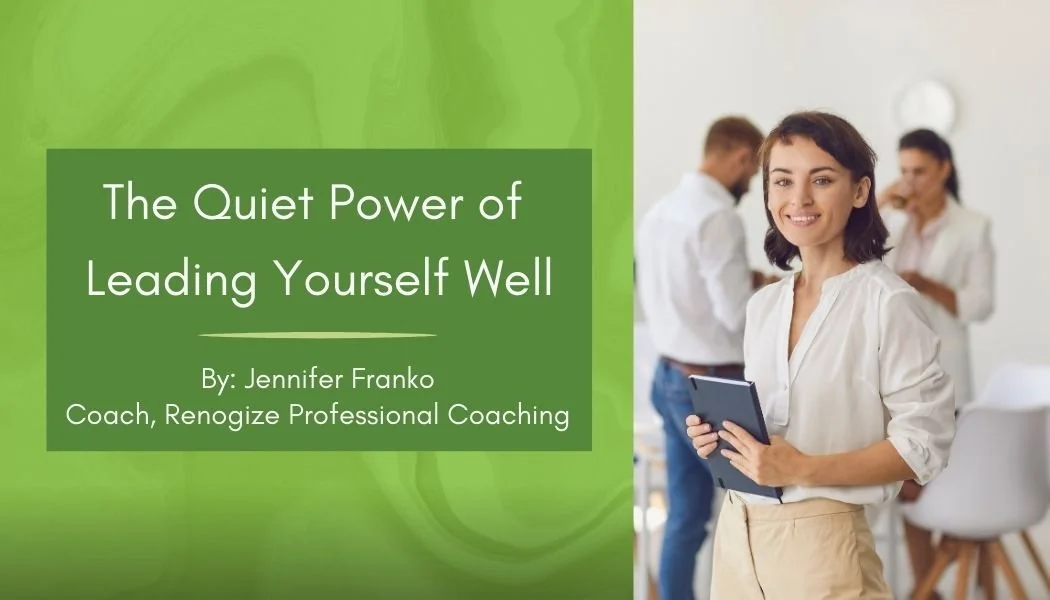
The Quiet Power of Leading Yourself Well
It seems safe to say, now and then, all of us struggle with leading ourselves well. I’ll speak for myself: Even on my best day, if I’m not intentional about keeping self-awareness high, I’ll trip up and stumble into, “Ugh. I wish I hadn’t said/done that.”
As a coach, leadership strategist, and woman of faith, I believe one of the greatest responsibilities we carry—whether in the boardroom, the sanctuary, the workplace, or our own families—is to steward ourselves well. And self-management / self-leadership is where emotional intelligence becomes real.
Self-Care is Self-Management
Steve identified that a key member of his team was performing at sub-optimum levels compared to normal. The staff member identified a few things that he needed from Steve so that he could be successful. The requests were reasonable and certainly within Steve’s control, but he chose to overlook and therefore deny them.
Failure in leadership, right? Right! How could someone possibly be so thoughtless and keep this staff member in his current struggling state? Failure indeed…only in this scenario, Steve was also the staff member. He failed to address his own needs.

Leading with Empathy
“I've learned that people will forget what you said, people will forget what you did, but people will never forget how you made them feel." – Maya Angelou
Take a moment to think of a leader who made a lasting impact on you. If you were to list all the characteristics that made them a great leader, chances are most of them are related to how they made you feel. Heard. Respected. Valued. In other words, the key to effective leadership isn’t what you know or even what you achieve – it’s leading with empathy.

Seeing is Leading
You may have heard about the Zulu tribe in South Africa who use a greeting, Sawubona, which translates to "I see you" or "We see you." This greeting acknowledges the presence and worth of the person being greeted. Wow. You had me at Sawubona.
One of the most powerful things a leader can do is really see the people they lead.
When you build awareness of others—what makes them tick, how they respond to challenges, what motivates or discourages them—you start unlocking your ability to lead in ways that are personal, human, and effective.
Accelerate Trust
“Trust takes time.” When I asked a recent client of mine “In what ways do you trust James?”, that was the response that I received. This is a common answer that I receive when I pose that question. You and I have probably felt or even said a version of the same thing at some point.
What we are all really saying is “Until I can predict the behavior, competency, and/or honesty of a person, I am uneasy and wary of them.” Once we have seen someone’s actions over several iterations of similar topics or challenges, we then know which box in our minds to put them into.
The problem is that we don’t have time to do that anymore! Our world is changing at a clip that our grandparents never could have imagined. Demands are changing…
The Window of Tolerance: A Key to Self-Awareness
As a leader, your ability to navigate challenges, make sound decisions, and inspire others depends on your capacity for self-awareness. One powerful tool for deepening that awareness is understanding your Window of Tolerance—the optimal state where you function at your best, emotionally and cognitively.
Coined by Dr. Dan Siegel, the Window of Tolerance describes the zone where you remain calm, present, and engaged. When you’re within this window, you can think critically, communicate effectively, and lead with clarity. However, stressors can push you outside of this optimal zone in two ways…
The Power of Self-Awareness in Leadership
Intentionally building self-awareness isn’t usually top of mind for leaders. Many clients say they’re too busy with responsibilities and managing distractions to make it a priority. If this resonates with you, humor me on this point:
Do not underestimate the power of self-awareness, especially in leadership.
Even amid responsibilities and distractions, you can still keep your finger on the pulse of self-awareness. Arguably, it’s the foundation of being an extraordinary leader.
Here are two simple questions to build self-awareness…
Executive Coaching Services For Leaders and their Teams
From a first-time manager to a C-suite executive team, there is a coaching path for every level of leadership. Start with one leader, or develop a group together.
Leadership Development
For organizations that want a cohort of leaders to grow together.
Executive Coaching
For individual leader, from first-time managers to C-suite executives and every role between.
Team Coaching
For an intact team that needs to work better together, or a good team ready to be great.
→ 30 minutes. Find out which service is the right fit, plus root issue identification and needs assessment regarding the leaders you want to grow.